

Mazagon Dock Shipbuilders IPO Review – Everything About Mazagon Dock IPO


 Copy link


 9 min read
If you’ve ever looked into India’s defense sector, you’ve probably come across the Mazagon Dock IPO. At first glance it might seem like just another PSU offering — but this one turned out to be way more interesting than most people expected.
The Mazdock IPO (also often called the Mazgaon Dockyard IPO) wasn’t just about listing a shipbuilding company. It became a case study of how government-backed companies can still deliver strong market performance. And that’s exactly where the Mazagon Dock share IPO price and later the Mazagon Dock listing price played a crucial role.
So before jumping into whether it was a good investment or not, let’s break down how everything actually looked.
Mazagon Dock Stock Quote & Price Chart
Let’s start with what happened after the company hit the market.
When Mazagon Dock got listed, the stock didn’t just sit quietly. The Mazagon Dock listing price came at a noticeable premium over the issue price, which immediately signaled strong demand. That kind of debut usually means one thing: the IPO was priced attractively enough to leave upside on the table.
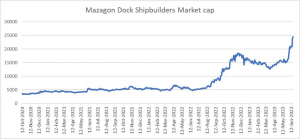
Over time, the stock’s historical performance followed a pretty typical PSU pattern at first — some sideways movement, periods of low excitement — and then a sharp re-rating when the defense sector started gaining attention again.
Looking at recent trading activity, you’ll notice a mix of consolidation phases and sudden upward moves. This usually points to institutional accumulation combined with retail participation, a pattern that often shows up in stocks like Mazdock IPO when the broader sector narrative turns positive.
Mazagon Dock IPO Overview
The Mazagon Dock IPO was an Offer for Sale by the Government of India, meaning the company didn’t raise fresh capital — instead, the government diluted its stake. This is pretty standard for PSU listings.
The shares were listed on both BSE and NSE, making them widely accessible from day one.
In terms of size, the issue was around ₹444 crore, with a face value of ₹10 per share. But what really mattered to investors was the Mazagon Dock share IPO price, which was set in the range of ₹135 to ₹145.
That price band wasn’t aggressive. In hindsight, the pricing played directly into the strong Mazagon Dock listing price we saw later.
Mazagon Dock IPO Timeline (Tentative Schedule)
The IPO opened on 29 September 2020 and closed on 1 October 2020. A short window that created a bit of urgency among investors. Allotments were finalized around 6 October, with refunds initiated shortly after on 7 October.
And then came the key moment: the listing on 12 October 2020. The Mazagon Dock listing price came in with a solid premium, which rewarded early investors right away.
Lot Size & Minimum Investment
From a retail investor’s perspective, the entry barrier was actually quite reasonable. The lot size was fixed at 103 shares, which meant the minimum investment (at the upper price band) came to around ₹14,935. That’s relatively accessible compared to many IPOs.
At the same time, the standard ₹2 lakh cap for retail investors applied, keeping things within the usual framework. In simple terms, the Mazgaon Dockyard IPO wasn’t just for big players. It was open to almost anyone with a Demat account, which naturally increased overall demand.
Category-Wise Reservation
Like most Indian IPOs, the allocation was split across different investor categories — and this balance plays a bigger role than many beginners realize.
About 50% of the issue was reserved for Qualified Institutional Buyers (QIBs), around 15% for Non-Institutional Investors (NIIs), and roughly 35% for Retail Individual Investors (RIIs). There was also a small employee quota, typically offered at a discount.
Promoter Holding & Shareholding Pattern
Before you invest in any IPO, it’s always worth asking: who actually owns the company? In the case of the Mazgaon Dock IPO, the answer is straightforward — the Government of India.
Before the IPO, the government held close to 100% of the company. Since this was an Offer for Sale, the stake was diluted slightly after listing, but the government still remained the dominant shareholder with a strong controlling interest.
That’s important for two reasons. First, it adds a layer of stability — PSU companies are rarely left on their own without support. But second, it also means decisions can sometimes be influenced by policy.
The reasonable Mazagon Dock IPO share price and Mazgaon Dockyard IPO price attracted strong interest across categories. Institutional investors (QIBs) took a significant chunk, which is usually seen as a positive signal. Retail participation was also solid, thanks to the accessible Mazgaon Dockyard IPO share price.
In short, the shareholding pattern ended up being fairly balanced but still clearly government-led.
About Mazagon Dock Shipbuilders Limited
Mazagon Dock Shipbuilders Limited is one of India’s leading defense shipyards. It’s not just building commercial vessels, its core focus is on warships and submarines for the Indian Navy. The company has been around for decades, and over time it has built a strong reputation in the defense manufacturing space.
Mazagon Dock has deep ties with the government — not just as a promoter, but also as its primary client. Most of its major contracts come directly from the Indian Navy and defense sector projects. This creates a relatively stable demand pipeline. Unlike private companies that constantly fight for market share, Mazagon Dock operates in a more protected ecosystem.
At the same time, it’s involved in complex, high-value projects — including submarine construction and advanced warships. These are not easy contracts to win or execute, which naturally limits competition.
Company Financials
Looking at the last three years before the IPO, Mazagon Dock showed fairly stable revenue growth. It wasn’t explosive — but it was consistent, which is often what you want from a PSU.
Profitability was solid as well. The company maintained healthy margins, supported by long-term defense contracts and relatively predictable cash flows. From a balance sheet perspective, Mazagon Dock was in a strong position. It had low debt levels and decent cash reserves.
Now let’s talk ratios:
- EPS (Earnings Per Share) was strong relative to the Mazagon Dock IPO share price, making the valuation look attractive at the time of listing
- RoNW (Return on Net Worth) indicated efficient use of capital
- NAV (Net Asset Value) supported the pricing, reinforcing that the Mazgaon Dockyard IPO price wasn’t stretched
Objects of the Issue
The Mazgaon Dock IPO was primarily an Offer for Sale. That means the company itself didn’t receive most of the funds, the government was simply reducing its stake. So if you’re looking for aggressive expansion funded by IPO money, that wasn’t the case here.
However, that doesn’t mean the company had no growth plans.
Mazagon Dock has been consistently investing in modernization, capacity expansion, and technology upgrades — especially to handle more complex defense projects. These initiatives are typically funded through internal accruals rather than IPO proceeds.
Risks & Considerations
No IPO is risk-free, and this one is no exception.
Industry-related risks
Defense manufacturing depends heavily on government spending. Any slowdown in defense budgets or delays in approvals can directly impact revenue visibility.
Operational and political risks
Because the government is both the promoter and the main client, there’s always a layer of political influence. Decisions may not always be purely profit-driven. Project delays are another factor. Shipbuilding, especially submarines, is complex, and timelines can shift.
Competitive landscape
While Mazagon Dock operates in a relatively protected segment, competition still exists, particularly from other public sector shipyards and emerging private players entering defense manufacturing.
Mazagon Dock IPO Review — Should You Apply?
Now comes the real question — was the Mazagon Dock shipbuilders IPO actually worth applying for, or was it just another PSU hype story? At the time of the IPO, the Mazagon Dock IPO price (₹135–₹145) was clearly on the attractive side.
Live Subscription Status
Fast forward to how the market values the company now:
- Market Cap: ₹1,06,597 Cr.
- Current Price: ₹2,644
- High / Low: ₹3,778 / ₹2,057
- P/E: 41.3
- Book Value: ₹242
- ROCE: 36.0%
- ROE: 29.2%
- Dividend Yield: 0.65%

The company is still fundamentally strong — high ROE and ROCE confirm that. But the valuation has expanded significantly. A P/E above 40 means the market is already pricing in a lot of optimism.
Start with the Free Demo Account
Mazagon Dock IPO Prospectus
If you really want to understand an IPO, the prospectus is where everything is laid out.
Mazagon Dock released both:
- DRHP (Draft Red Herring Prospectus)
- RHP (Red Herring Prospectus)
These documents covered all the essentials: business model, financials, risks, and future outlook.
Key takeaways from the prospectus:
- Strong order book from defense sector projects
- High reliance on a single client (Government of India)
- Long execution cycles for shipbuilding contracts
Listing Day Performance
The Mazagon Dock IPO price was ₹135–₹145, and the stock opened at a solid premium, immediately rewarding investors who got an allotment. This is typical for a well-priced IPO: initial excitement, followed by some correction, and then price discovery.
Company Contact Details
For official communication and investor queries:
- Company: Mazagon Dock Shipbuilders Limited
- Head Office: Mumbai, India
- Phone: +91-22-23762000, +91-22-23763000, +91-22-23764000
IPO Registrar Details
Every IPO has a registrar handling the backend process: allotments, refunds, and investor queries. For the Mazagon IPO, this role was handled by Link Intime India Private Limited. They’re one of the largest IPO registrars in India, and if you’ve ever applied for an IPO before, chances are you’ve already interacted with them.
Lead Managers & Underwriters
Behind every IPO, there’s a team making sure everything runs smoothly — from pricing to investor outreach.
For the Mazagon Dock IPO, the lead managers included:
- ICICI Securities
- Axis Capital
- Edelweiss Financial Services
- JM Financial
They’re the ones who connect the company with the market and their pricing decision directly impacts whether an IPO succeeds or fails. In the case of Mazagon Dock, the pricing strategy worked well, which is why the IPO saw strong demand and a solid listing.
FAQ
When was Mazdock listed?
Mazagon Dock was listed on 12 October 2020 on both BSE and NSE.
Is Mazagon Dock a good stock to buy?
Fundamentally, it’s a strong company with high ROE and stable government-backed demand.
What is the IPO listing price?
The stock listed at a premium over the issue price band of ₹135–₹145, delivering immediate gains to investors.
Is Mazagon Dock debt free?
The company has historically maintained low debt levels, making its balance sheet relatively strong compared to many peers.
What is Mazagon Dock IPO?
It was a public offering by Mazagon Dock Shipbuilders Limited, primarily an Offer for Sale by the Government of India to dilute its stake.
How to apply via Zerodha or other platforms?
You can apply through platforms like Zerodha Kite or any broker offering IPO access. Just go to the IPO section, select the issue, enter bid details, and approve the mandate via UPI.
Is there a retail investor discount?
Yes, a small discount was typically offered to retail investors and employees, making the IPO slightly more attractive.
When is the allotment/listing date?
Allotment was finalized around 6 October 2020, and listing took place on 12 October 2020.
How many shares are in one lot?
One lot consisted of 103 shares.